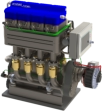
Hydrogen
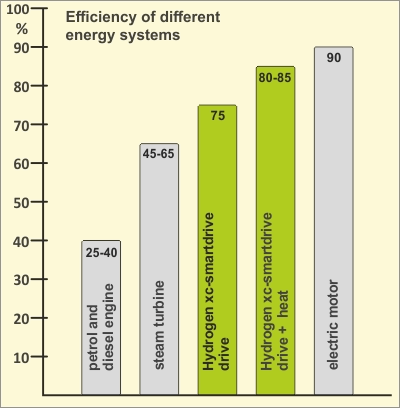
xc-smartdrive





With
an
efficiency
of
up
to
80%,
the
Hydrogen
xc-smartdrive
is
an
exceptional
internal
combustion
engine
–
clearly
superior
to
conventional
designs.
It
is
not
a
miracle
machine,
but
a
system
that,
thanks
to
specially
designed technical components, can fully utilize the hydrogen cycle for efficient energy generation.
Inside
the
engine,
hydrogen
and
oxygen
combust
to
form
water
vapor
–
at
temperatures
of
up
to
3,300
°C
(5,972
°F).
The
resulting
expansion
of
the
steam
is
directly
used
to
generate propulsion energy.
When
the
steam
is
actively
cooled
during
or
after
combustion,
additional
usable
heat
is
recovered.
At
the
same
time,
the
vapor
condenses
into
water,
creating
a
vacuum
–
which
can
also
be
harnessed
to
produce
mechanical work.
Only
hydrogen
enables
such
a
dual-action
process
–
something
that
conventional
gasoline,
gas,
or
diesel
engines cannot achieve.
The
theoretically
achievable
efficiency
of
this
process,
based
on
the
Carnot
factor,
exceeds
90%.
In
real-world
applications,
up
to
75
%
is
realistic
–
a
remarkable
value
for
an internal combustion engine.
These
properties
make
hydrogen
one
of
the
most
efficient
energy carriers for propulsion systems and heat pumps.
However,
fully
exploiting
the
potential
of
this
cycle
requires
an engine with very specific characteristics.
And
that
is
exactly
where
the
Hydrogen
xc-smartdrive
technology comes into play.


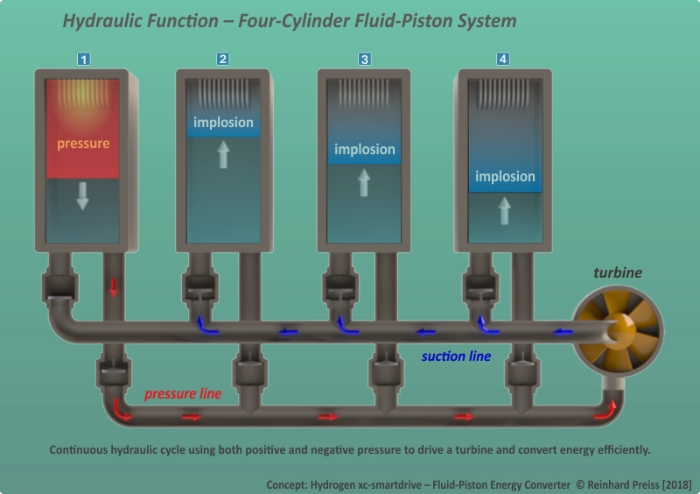
The
system
uses
communicating
fluid
pistons.
While
one
cylinder
is
in
the
combustion
or
pressure
phase,
the
others
are
in
the
cooling
and
condensation
phase.
Optimal
operation
is
achieved
with
four
cylinders,
as
the
cooling
of
the
steam
takes
more
time
than combustion.
A
minimum
of
two
cylinders
is
required,
although
this
significantly
limits
efficiency.
The
number
of
cylinders
is
unlimited, which is reflected in the name “xc” (x cylinders).
Mechanical
power
is
extracted
from
the
working
fluid
via
a
turbine.
The
turbine
geometry
defines
the
output
shaft
speed
and allows for simple adjustment to the desired RPM range.
One
of
the
key
advantages
of
fluid
pistons
is
their
variable
stroke:
the
stroke
length
depends
on
the
amount
of
hydrogen
and
oxygen
supplied,
the
performance
of
the
heat
exchanger,
and
the
motor
control
unit.
The
piston
reverses
direction
precisely
when
the
phase
transition
from
steam
to
water
begins
–
a
crucial
factor
for
achieving
high
efficiency.
Conventional
piston engines with a fixed stroke cannot offer this adaptability.
In
addition,
fluid
pistons
operate
virtually
without
wear
and
require
no
lubricants
or
maintenance
fluids
–
paving
the
way
for
a low-maintenance and sustainable propulsion system.
The
Hydrogen
xc-smartdrive
is
a
relatively
simple
machine
compared
to
today’s
gasoline
and
diesel
engines
and
can
be
manufactured
around
30%
more
cost-effectively
in
series
production.
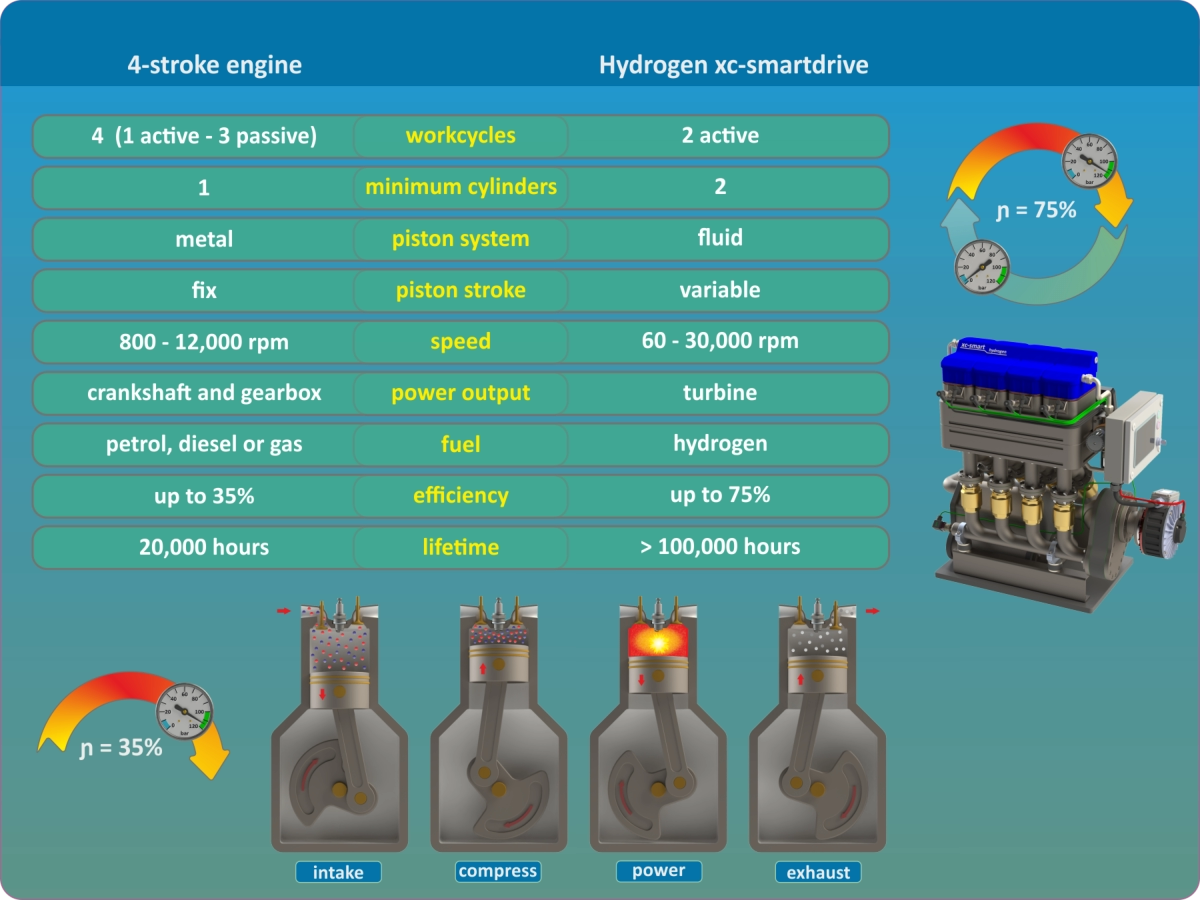
Technically,
it
is
a
two-stroke
engine
with
a
hydraulic
fluid
piston
system
–
but
it
operates
fundamentally
differently
from
conventional
two-stroke
engines:
every
stroke is a power stroke.

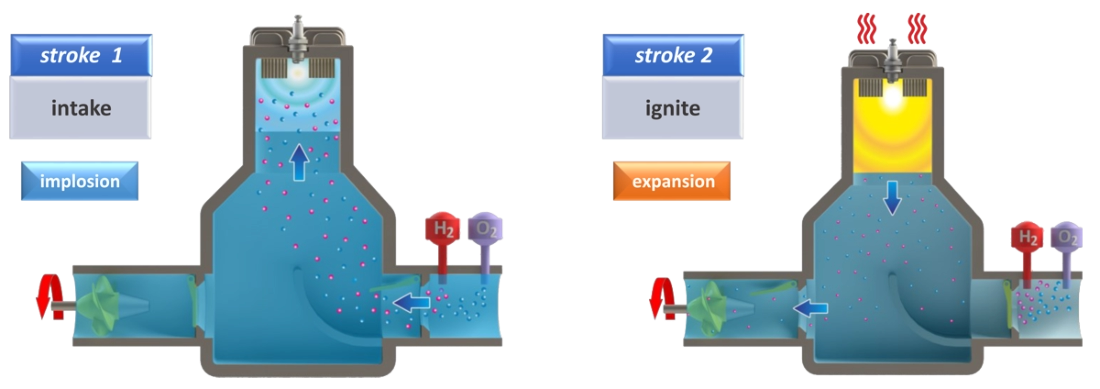
The
Hydrogen
xc-smartdrive
is
a
hermetically
sealed
two-stroke
engine,
specifically
designed
to
match
the
hydrogen
combustion
cycle.
Unlike
conventional
two-stroke
engines,
its
operation
is
fundamentally
different.
Hydrogen,
when
combusted,
transforms
into
steam,
which
can
then
be
condensed
back
into
water
through
cooling.
This
phase
transition releases an additional form of energy – the energy of implosion – which conventional combustion engines are not designed to exploit.
The
Hydrogen
xc-smartdrive
is
the
first
and
only
thermal
engine
with
communicating
fluid
pistons
that
performs
a
power
stroke
in
every
cycle.
As
a
result,
it
achieves
efficiencies
of up to 80%.
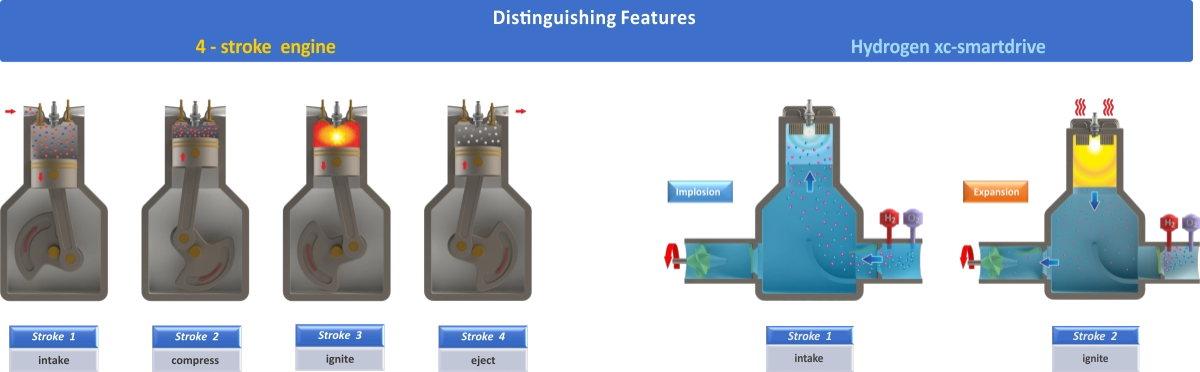
Cycle 1 – Intake
The
cycle
begins
with
the
intake
of
a
combustible
gas
mixture
–
either
hydrogen
with
pure
oxygen
or
hydrogen
with
atmospheric
air,
depending
on
the
system
configuration.
This
mixture
is
introduced
directly
into
the
working
fluid
after
the
turbine stage.
Within
the
cylinder,
the
condensation
of
steam
creates
a
vacuum,
which
sucks
the
fluid
and
the
gas
mixture
into
the
chamber.
A
dedicated
heat
exchanger
module
is
integrated
into
the
cylinder
to
facilitate
this
condensation
process
(details
provided
in a later section).
The
hydrogen
gas
bubbles
within
the
fluid
rise
into
the
upper
section
of
the
cylinder,
where
they
accumulate
and
form
a
homogeneous,
combustible
mixture
–
ready
for
the next power stroke.
Cycle 2 – Ignition and Combustion
The
gas
mixture
is
ignited
by
a
spark
plug,
with
the
ignition
timing
electronically
controlled
according
to
the
desired
power
output
and
engine
speed.
Hydrogen
burns
almost
instantaneously,
in
just
a
few
milliseconds,
generating
high-
temperature steam that drives the fluid piston.
Due
to
the
thermal
inertia
of
the
heat
exchanger,
cooling
of
the
steam
begins
primarily
during
the
next
intake
phase.
The
resulting
condensation
creates
an
implosive vacuum that contributes additional mechanical energy.
Mechanical
energy
is
extracted
from
the
fluid
via
a
turbine,
with
the
turbine’s
geometry determining the shaft speed.
By
precisely
coordinating
the
piston
stroke,
hydrogen
supply,
heat
exchanger
performance,
and
turbine
characteristics
through
an
engine
control
unit,
the
Hydrogen xc-smartdrive can operate efficiently across a wide RPM range.
Hydrogen Supply
The Hydrogen xc-smartdrive can be powered by hydrogen in two main configurations:
1.
Internal Electrolysis
Primarily
used
for
heat
pump
applications,
hydrogen
is
generated
directly
within
the
system
via
electrolysis.
The
electrolysis
unit
is
integrated
into
the
suction
line
behind
the
turbine.
An electrical efficiency of 85–90% is expected. Any thermal losses are recovered and upgraded to a higher, usable temperature level by the engine, effectively offsetting the losses.
2.
External Hydrogen Supply
Preferred
for
stationary
applications
where
hydrogen
storage
tanks
are
available.
The
engine
can
be
supplied
with
either
a
hydrogen-air
mixture
or
a
hydrogen-oxygen
mixture.
Using
pure
oxygen
eliminates
NOx
emissions
during
combustion
and
makes
use
of
the
oxygen
that
is
already
a
byproduct
of
electrolysis.
In
this
case,
hydrogen
and
oxygen
must
be
stored
separately.
3.
Hybrid Supply
A
combined
approach
using
both
internal
electrolysis
and
external
hydrogen
tanks
is
also
possible.
This
hybrid
system
could
be
particularly
advantageous
for
electric
mobility,
allowing
greater range and faster refueling – increasing user acceptance and practical viability.
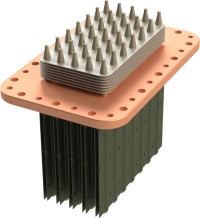
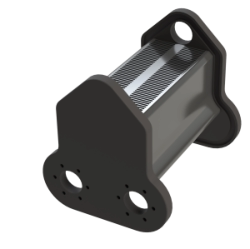
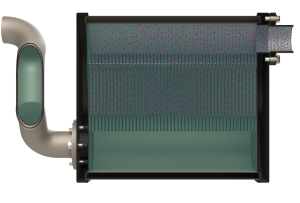
Heat Exchanger Module
The
heat
exchanger
module
integrated
into
the
cylinder
is
one
of
the
key
components
of
the
bidirectional
fluid
piston
system
within
the
hermetically
sealed
design
of
the
Hydrogen
xc-smartdrive.
Its
primary
function
is
to
rapidly
and
precisely
transfer
the
thermal
energy
generated
during
combustion
to
an
external
medium
–
such
as
water – making it available for subsequent thermodynamic processes.
The
module
must
meet
extremely
demanding
requirements:
it
must
withstand
combustion
temperatures
of
up
to
3,300
°C
(5,972
°F)
for
short
durations
and
simultaneously
cool
the
hot
steam
quickly
enough
to
induce
condensation.
This
rapid
phase
transition
from
steam
to
water
results
in
a
significant
volume
reduction,
which
the
Hydrogen xc-smartdrive
harnesses to generate a second active power stroke.
To
ensure
precise
thermal
regulation,
the
module
is
sensor-integrated
and
connected
to
the
engine
management
system.
The
collected
data
influences
various
operational
parameters,
including
stroke
length
and
fuel
dosing
–
making the heat exchanger a critical factor in the system’s overall efficiency and responsiveness.

In both internal electrolysis and external supply of hydrogen and oxygen, the gases are introduced into the fluid system after the turbine and transported into the cylinder chamber via
the working fluid. This method offers the advantage that the gas bubbles carry microscopic water particles into the cylinder. When the hydrogen mixture is ignited, these water particles
absorb heat and help reduce the peak combustion temperature. The resulting steam contributes to:
- a more uniform pressure distribution and extended pressure duration,
- improved impulse transfer to the fluid piston,
- enhanced heat recovery and more precise thermal regulation during the implosion phase.
Various options are currently under consideration for supplying the Hydrogen xc-smartdrive with hydrogen and atmospheric oxygen. These will be tested and refined in the course of
further development.
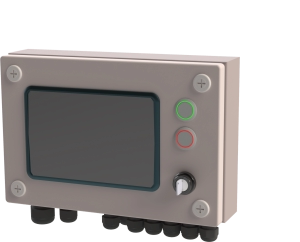
Engine Control Unit – Intelligent Regulation for Maximum Efficiency
The
engine
control
unit
(ECU)
handles
all
monitoring
and
regulation
tasks
for
the
Hydrogen
xc-smartdrive.
Unlike
conventional
rigid
systems,
this
drive
is
designed
to
support
multiple
operating
modes,
requiring
precise
control
of
internal and external energy flows to maintain high overall efficiency.
One
key
feature
of
the
ECU
is
its
ability
to
adjust
the
ratio
between
mechanical
power
output
(e.g.,
for
electricity
generation)
and
heat
dissipation.
This
is
particularly
valuable
in
combined
heat
and
power
(CHP)
systems,
where
electricity and thermal energy are rarely needed in fixed proportions.
The
development
of
the
ECU—including
hardware
and
software—accounts
for
roughly
25
to
30
percent
of
the
system's
overall
development
effort.
The
ultimate
goal
is
a
universal
control
unit
that
supports
all
intended
applications: from heat pumps and stationary CHP systems to mobile solutions.
Both
the
control
logic
and
operational
software
are
open
source.
All
documentation
is
made
publicly
available,
allowing
future
users
to
develop
their
own
control
systems
or
rely
on
standard
solutions.
This
openness
ensures
flexibility,
transparency,
and
long-term
adaptability—aligned
with
the
collaborative
spirit
of
the
Hydrogen
xc-
smartdrive project.

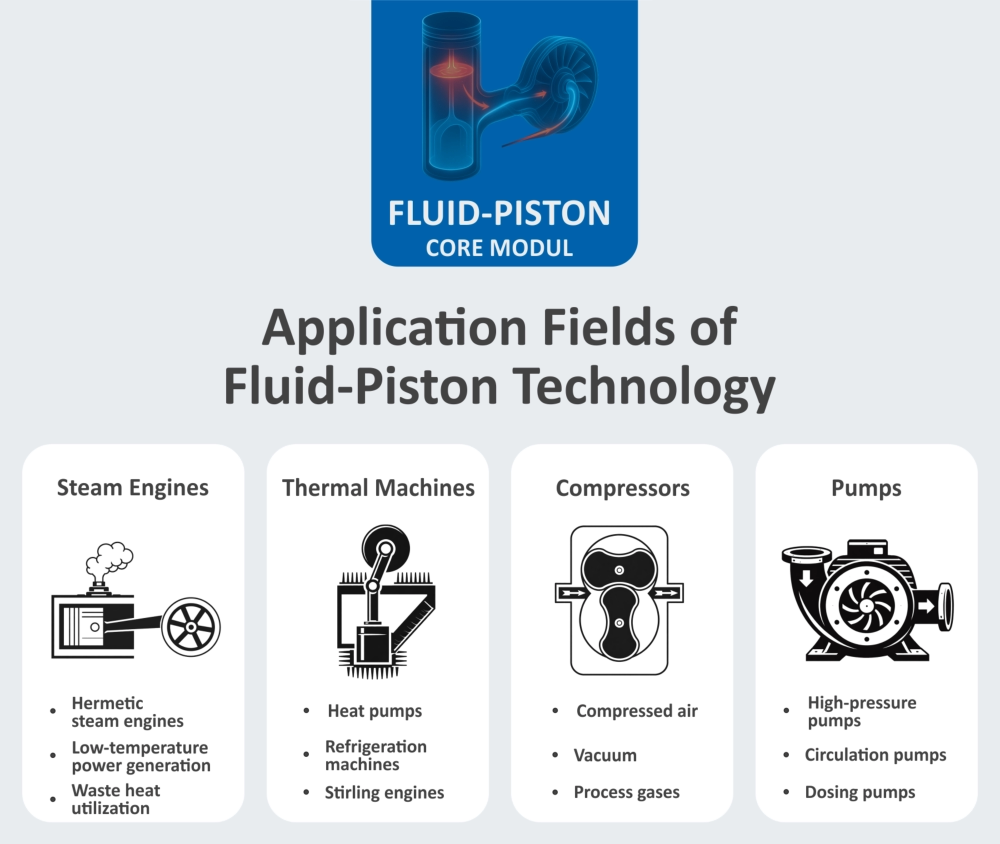
The
fluid
piston
technology
developed
in
the
Hydrogen
xc-smartdrive
is
far
more
than
just
a
drive
system
–
it
serves
as
a
versatile
core
module
for
harnessing,
storing,
and
converting
thermal
and
mechanical
energy.
Whether
used
as
a
hermetically
sealed
steam
engine,
a
high-efficiency
Stirling
engine,
a
pressure-resistant
gas
pump,
or
a
heat
pump
unit,
the
fluid
piston
opens
up
entirely
new
possibilities
for
sustainable
and
resource-efficient
machine
designs.
It
may
even
revive
and
modernize
some
long-forgotten
machine
types
from
past
centuries,
turning
them
into
viable
tools
for
utilizing renewable energy sources.
Fluid
pistons
offer
several
key
advantages:
they
are
fully
sealed
against
gas
and
combustion
chambers,
generate
minimal friction within the cylinder, and operate without the need for lubricants.
Producing fluid-based drives is more cost-effective and requires fewer resources.
High-Efficiency Electrolysis Unit
For
internal
HHO
gas
production,
the
Hydrogen
xc-smartdrive
uses
a
specially
developed
electrolysis
unit.
All
electrodes are fully immersed in a common, circulating electrolyte bath — the system’s working fluid.
Each
cell
consists
of
one
anode
and
one
cathode,
both
individually
contacted
and
precisely
voltage-controlled.
To
prevent
short-circuit
currents
within
the
electrolyte,
each
cell
is
separated
by
insulating
frames.
This
ensures
that
current flows exclusively between two adjacent plates in a controlled and efficient manner.
With
an
exact
voltage
control
of
approximately
1.25
V
per
cell
and
a
moderate
current
density
of
50–70
mA/cm²,
the
unit
achieves
an
efficiency
of
up
to
95
%.
It
is
designed
for
continuous
operation
and
is
integrated
directly
into
the fluid system downstream of the turbine. The produced gas is delivered directly into the engine cylinders.
The continuous flow of system fluid ensures optimal electrode cooling and a high detachment rate of gas bubbles.
Internal
electrolysis
is
mainly
used
in
heat
pump
operation
or
in
combined
applications,
such
as
mobility
systems
or compressors.
The
prototype
we
have
developed
and
documented
is
a
universally
applicable
machine
designed
to
cover
a
broad
range
of
applications.
It
serves
as
a
technological
foundation for future developers, researchers, and manufacturers—both for serial production and further development of the Hydrogen xc-smartdrive.
The
prototype
operates
using
both
internally
generated
and
externally
supplied
hydrogen,
enabling
realistic
testing
and
evaluation
of
different
operating
modes.
The
initial
version
of
the
base
unit
will
have
a
displacement
of
approximately
3
liters
and
is
expected
to
deliver
a
total
output
of
80
to
120
kW.
In
future
development stages, higher performance levels will also be achievable with this engine size.
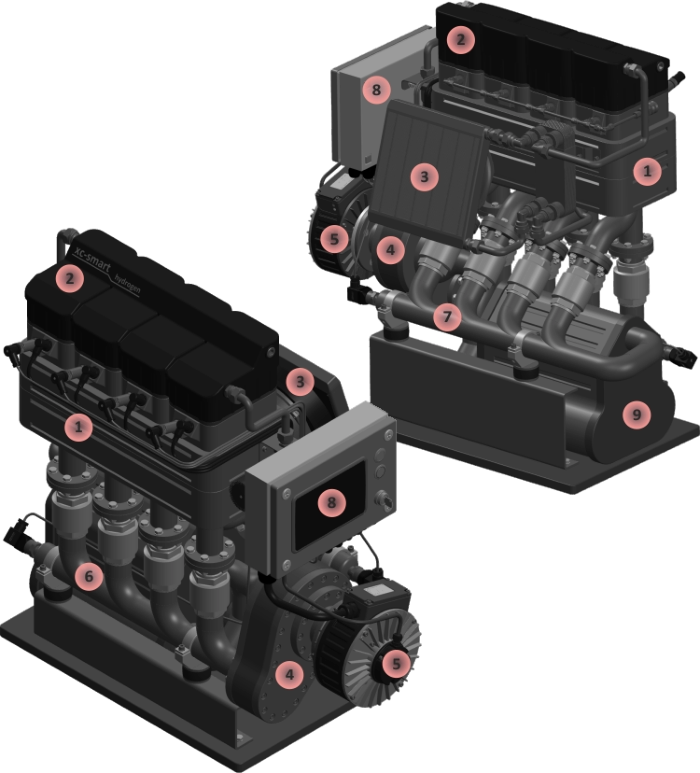
Main components of the prototype
1
Engine block
2
Cooling system for the
heat exchanger modules
3
Main radiator
4
Turbine unit
5
Generator and starter motor
6
Pressure line
7
Suction line
8
Engine control unit
9
High-efficiency electrolysis unit
This
construction
approach
reflects
an
important
development
step:
transitioning
from
the
concept
of
a
hermetically
sealed
steam
engine
to
the
final
hydrogen-powered
version.
Using
steam
during
this
intermediate
phase
allows
for
more
precise
performance
measurements
and
a
more
controllable
reaction
dynamic,
which
is
particularly
beneficial
for
the
development
and
tuning of control systems.
The current setup is therefore ideal for:
-
understanding the system’s functional principles in detail
-
targeted component development
-
metrological validation of process steps
-
thermodynamic and energy efficiency optimization
-
development of software-based control algorithms
T
he
prototype’s
current
design
is
intentionally
functional
and
modular.
It
provides
easy
access
to
all
core
components
for
testing,
measurement,
and
optimization.
Future
production
models
of
the
Hydrogen
xc-smartdrive
will
be
more
compact
and aesthetically refined.


The Process at a Glance
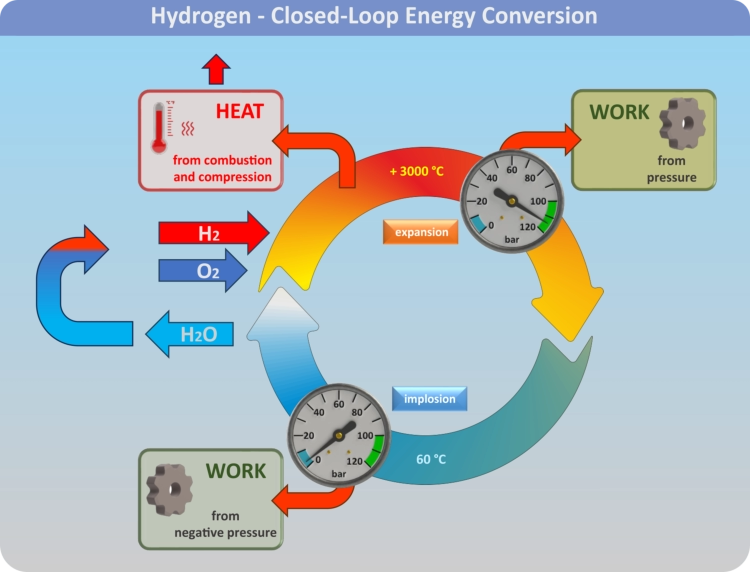
The Hydrogen xc-smartdrive converts hydrogen into mechanical energy in two phases:
through expansion after combustion – and then through implosion via condensation.
This dual-phase energy usage makes it fundamentally different from any conventional combustion engine.
Expansion – the first energy phase
During controlled combustion of HHO gas in the cylinder, temperatures reach 2700 to 3000 °C, and pressure can spike up to 300 bar depending on the fuel mixture.
The key innovation: The fluid piston does not follow a fixed mechanical path. Instead, it dynamically absorbs the pressure pulse with minimal loss. This enables near-complete
conversion of explosive force into mechanical motion.
Estimated efficiency of this phase: 60–65 %
based on 1 liter of hydrogen gas with ~12.7 kJ chemical energy → approx. 8.25 kJ usable work
Implosion – the second energy phase
After
combustion,
steam
condenses
at
~25–50
°C.
This
creates
a
strong
vacuum
in
the
cylinder,
pulling
the
piston
back
and
simultaneously
drawing
in
fresh
gas
for
the
next
cycle.
From 1 liter of HHO gas, about 0.9 grams of water are produced. This condensation releases an additional ~2.0
kJ of energy, which is also converted into work by the engine.
Total Output and Theoretical Efficiency
Combined mechanical output:
8.3 kJ from expansion + 2.0 kJ from implosion = 10.3 kJ mechanical work from 12.7 kJ chemical energy
That equates to a theoretical efficiency of about 81 %.
Why the xc-smartdrive might exceed expectations
Several technical design features suggest that even higher efficiency levels may be possible:
- The fluid piston moistens the cylinder walls, generating additional steam –
and thus more usable energy.
- It also cushions heat spikes, protecting the engine and improving long-term durability.
- Its low-friction, oil-free operation minimizes internal losses.
Our Goal: 75 % Real-World Efficiency
Our development target is a real-world mechanical efficiency of at least 75 % –
the highest level ever achieved by a combustion-based engine.
The Hydrogen xc-smartdrive isn’t just a machine.
It’s a technological milestone for the clean energy future.
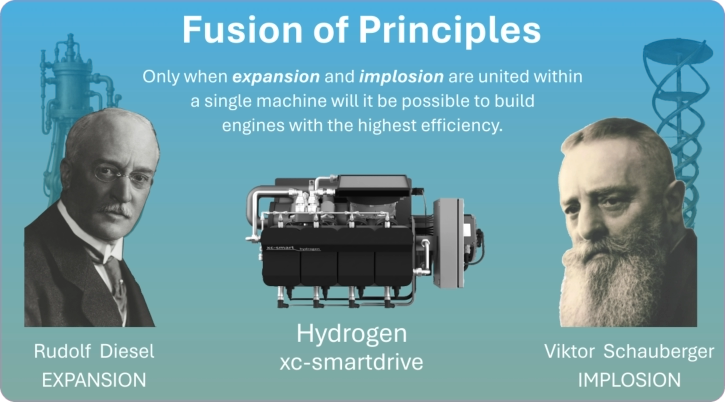
For
more
than
a
century,
engines
have
relied
on
expansion
–
the principle that drove
Rudolf Diesel’s
invention.
At
the
same
time,
Viktor
Schauberger
explored
the
natural
power
of
implosion
,
a
movement
that
concentrates
energy
instead of dispersing it.
The
Hydrogen
xc-smartdrive
unites
these
two
opposites
in
one
system
–
expansion
and
implosion
working
together
in
a
continuous cycle.
This
fusion
of
principles
makes
it
possible
to
achieve
exceptional
efficiency,
simplicity,
and
sustainability
in
a
single
open-source
machine.
Where the old world of mechanics meets the new world of natural
flow – the future of clean energy begins.
Introduction
The technology of the Hydrogen xc-smartdrive